
Take Inventory
Capabilities times access methods — count your workflows.
TUTOR WITH THEFOCUS.AI
Copy this prompt into Claude, ChatGPT, or any external AI assistant. It points the assistant to the course instructions and links it to your student profile to track your progress and customize observations.
You are not enrolled yet. Enroll to generate a Student ID to track lesson completions and store learning notes.
Count what you have built
Before we talk about compound effects, take inventory. List everything you have built across the book — every skill, every MCP connection, every routine, every channel, every habitat.
Cornwall Market’s inventory:
| Type | What | Chapter |
|---|---|---|
| Skill | Transaction categorization rules | Ch 04 |
| MCP | QuickBooks — vendors, invoices, transactions | Ch 07 |
| MCP | Chrome DevTools — supplier portal access | Ch 08 |
| MCP | Custom rules server — categorization logic as API | Ch 07 |
| Routine | Monday morning financial summary | Ch 07 |
| Channel | Invoice arrival webhook → auto-categorize | Ch 07 |
| Habitat | Bookkeeping agent with self-modify | Ch 09 |
That is 7 capabilities. And there are 5 access methods: terminal (Claude Code), phone (Remote Control and Dispatch), cloud sessions (claude.ai/code), events (Channels), and recurring (Routines).
Now multiply.
List every skill, MCP connection, routine, channel, and habitat you have built or configured while reading this book. Count the capabilities. Count the access methods. Multiply.
Cornwall Market: 7 capabilities × 5 access methods = 35 possible workflows. The categorization skill alone is not just a terminal command — it is a terminal command, a remote-triggered action, a dispatched task, a channel response, and a scheduled routine. Five workflows from one skill.
Not additive — multiplicative
Most people think about AI capabilities as a list. I added a skill, now I have one more thing Claude can do. I connected an MCP server, now I have two more things. Additive. Linear. Wrong.
The correct mental model is multiplication:
Capabilities (skills + MCP servers)
  × Access Methods (terminal + phone + cloud + channels + routines)
= Total WorkflowsAdditive thinking: 7 capabilities = 7 things Claude can do
Multiplicative reality: 7 capabilities × 5 access methods = 35 workflows
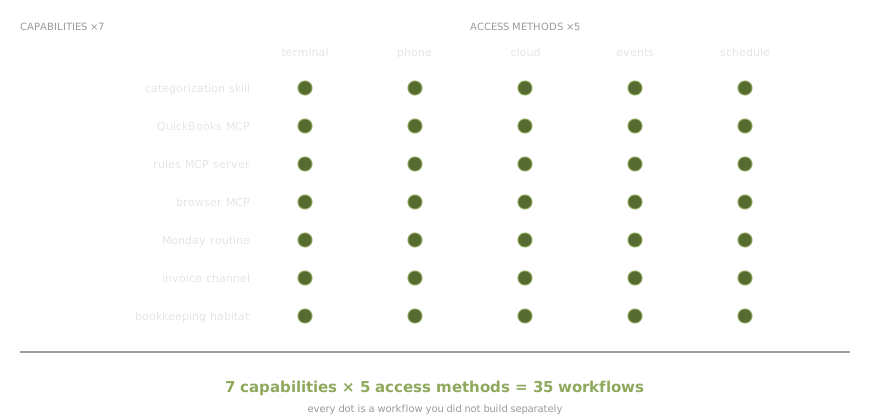
Every new skill you add does not just add one workflow. It adds one workflow per access method. Every new access method you enable does not add one workflow. It adds one workflow per capability. When you set up Channels in Chapter 07, every existing skill and MCP server became event-triggered. When you added Remote Control in Chapter 06, every existing capability became phone-accessible.
This is why the progression matters. Each chapter did not just teach you one thing — it multiplied everything you already had.
There is a second compounding effect beyond the multiplication: the data flywheel. Outputs become inputs for the next cycle. The Monday morning report (output) reveals a pricing trend. You correct a categorization (output). That correction feeds back into the skill (input for the next cycle). The system gets better each time it runs. Data flows in, gets processed by your skills, flows out transformed — and the transformation itself generates knowledge that improves the next transformation.
The multiplication is spatial — capabilities times access methods. The flywheel is temporal — each cycle improves the next. Together, they are what makes a compound system fundamentally different from a collection of automations.
Check your understanding
Answer in your own words — write it down before opening the key. Your tutor grades against the criteria and generates fresh variants on retries.
Q1. Compute the workflow count for your own current inventory (capabilities × access methods) — then identify the single cheapest addition that would grow the count the most, and say why it wins.
Q2. The multiplication is spatial; the flywheel is temporal. Explain both compounding effects and give one concrete example of each from the Cornwall Market system.
Answer key — attempt every question first
Answer key
Q1
Model answer: Any honest count passes. The insight being tested: when capabilities outnumber access methods, adding an access method multiplies by the full capability count — usually the cheapest win (e.g. adding channels makes every existing skill and connection event-triggered). Adding one more capability adds only one row.
Pass criteria: does the multiplication on their own inventory; picks the scarcer dimension to grow; explains with the multiplication logic
Q2
Model answer: Spatial: capabilities × access methods — the categorization skill is simultaneously a terminal command, phone action, dispatched task, channel response, and scheduled routine. Temporal: outputs feed the next cycle — Sarah’s correction to one categorization updates the skill, so every future run is better; the Monday report reveals the pricing trend that becomes a new monitoring rule.
Pass criteria: both effects correctly characterized; one concrete example each (multi-surface skill; correction/report feeding back)
Next: Architecture Patterns