
The Map: Four Transitions
The roadmap for the course — maturity levels, transitions, and the Claude ecosystem.
TUTOR WITH THEFOCUS.AI
Copy this prompt into Claude, ChatGPT, or any external AI assistant. It points the assistant to the course instructions and links it to your student profile to track your progress and customize observations.
You are not enrolled yet. Enroll to generate a Student ID to track lesson completions and store learning notes.
The roadmap
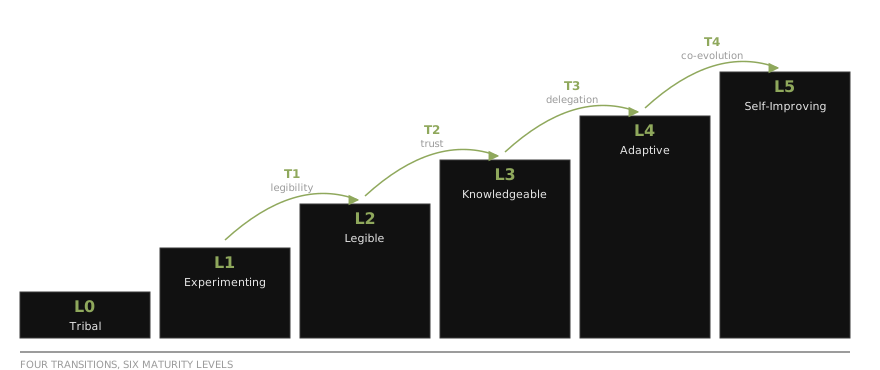
This course is built around four transitions. Each one is load-bearing. Each one builds on the one before. And each one changes what you physically do with AI tools.
Transition 1: Making the organization legible. Can the company describe its own work to a machine? This is where Cornwall Market starts. Sarah will walk through her store, dictating categorization rules into her phone. She will turn tribal knowledge into structured documents called skills. The output is not a demo — it is a spreadsheet of vendor mappings and a document that explains what account codes mean and why.
Transition 2: Trusting your own data. Can people act on what the system tells them? Sarah will connect Cornwall Market’s actual data — invoices, QuickBooks records, supplier lists — to Claude through MCP, the Model Context Protocol. She will test the system against real invoices and discover that it catches errors she was missing. In a parallel deployment at Fountain Creek (a multi-location food service company), this same pattern hit 94.5% accuracy — and the machine caught human errors the humans had missed. Trust inverted.
Transition 3: The system starts acting. Does the system surface insights before being asked? Cornwall Market’s invoice processing moves from manual to semi-automated. Instead of Sarah opening each PDF, reading line items, and typing data into accounting software — 10 to 15 minutes per invoice, errors common — the system processes incoming invoices, flags exceptions, and presents categorized results for review. Delegation tools like Dispatch and cloud routines make this always-on.
Transition 4: The system changes how the org works. Does the system learn from its own operation? When Sarah corrects a categorization, that correction feeds back into the system’s knowledge. When a new supplier appears, the system proposes an account mapping based on patterns it has learned. The organization and the system co-evolve.
Here is the concrete map of what you will do, chapter by chapter:
| Chapter | Transition | What You Build | Cornwall Market Arc |
|---|---|---|---|
| 01 | Orientation | Your legibility gap list | Sarah discovers what Claude doesn’t know |
| 02 | Orientation | Voice capture, camera input, phone-to-laptop handoff | Sarah dictates vendor rules walking the aisles |
| 03 | Orientation | Your first shareable artifact — a working web page | The staff cheat-sheet goes on the register iPad |
| 04 | T1: Legibility | A Project, then your first SKILL.md | The dictated rules become structured knowledge |
| 05 | T2: Trust | Connectors, Cowork analysis, your MCP roadmap | Claude finds errors in Cornwall Market’s books |
| 06 | T3: Delegation | Claude Code, Remote Control, cloud sessions | Invoice processing moves from manual to agent-assisted |
| 07 | T3: Always-on | MCP connections, routines, channels | Daily invoice processing runs automatically |
| 08 | T3: Last mile | Computer Use for systems without APIs | Handling the vendor portal that only has a web interface |
| 09 | T4: Production | Agents with eval and feedback | The system learns from Sarah’s corrections |
| 10 | T4: Compound | The full system | All pieces working together, continuously improving |
The transitions are sequential. You cannot skip them. But you can start from wherever you are.
There is a second thread running through these chapters that is just as important as the transitions: the distillation pipeline. Every conversation you have with Claude is a potential source of organizational knowledge. The course follows a progression from the most informal capture to the most formal:
| Form | What It Is | Chapter |
|---|---|---|
| Conversation | You talk to Claude, explain how things work | Ch 01-02 |
| Project instructions | Knowledge pinned to a Project so every chat inherits it | Ch 04 |
| CLAUDE.md | Notes from conversations saved as persistent instructions | Ch 04 |
| SKILL.md | Structured knowledge with rules, tables, exceptions | Ch 04 |
| MCP server | Knowledge exposed as tools any surface can call | Ch 07 |
| Habitat | Self-modifying agent that updates its own skills from corrections | Ch 09 |
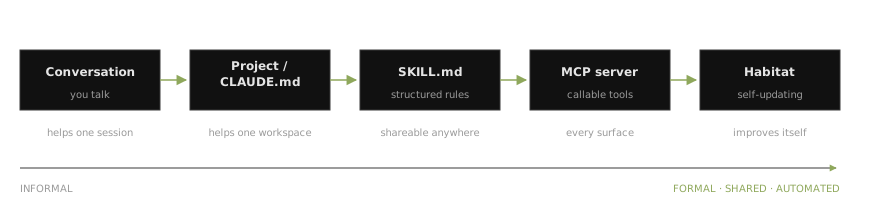
Each step increases the formality, the shareability, and the automation. A conversation helps one person in one session. Project instructions help every chat in one workspace. A SKILL.md helps every project that installs it. An MCP server makes the knowledge available across every Claude surface. A habitat closes the loop — corrections flow back in and the system improves itself.
The key insight: don’t just ask Claude to do things. Ask it to document how it did them so it can do them again. Every discovery gets documented back into the system. That is how a conversation becomes an agent.
The maturity framework
Before you move forward, figure out where you stand. The maturity levels below describe how an organization relates to AI systems — not how many AI tools it has purchased, but how deeply AI is woven into how work actually gets done.
| Level | Name | What It Looks Like |
|---|---|---|
| L0 | Tribal | Processes run on tacit knowledge and habit. Rules live in people’s heads. A new hire learns by shadowing for weeks. |
| L1 | Experimenting | Individuals use AI tools — ChatGPT, Claude, Copilot — but nothing is shared. Each person’s setup is their own. |
| L2 | Legible | The organization can describe its own work to a machine. Tribal knowledge is captured in shareable skills and documents. |
| L3 | Knowledgeable | Proprietary data is connected and verifiable. The system can reference your actual records, not just general knowledge. |
| L4 | Adaptive | The system surfaces insights before being asked. Delegation tools let it act within defined boundaries. |
| L5 | Self-Improving | The system learns from every interaction. Corrections feed back. The organization and the system co-evolve. |
Cornwall Market is solidly L0. The categorization rules live in Sarah’s head. Supplier relationships are personal — she knows that Chen’s Produce always rounds up on invoices by a dollar or two, and it is fine because they have worked together for twelve years. Exception handling is oral tradition: “If the broad-line distributor ships a substitution, call them before you pay the invoice.” “If a bakery supplies order is over $800, double-check because they sometimes double-ship flour.” None of this is written down. None of it is shareable. If Sarah wins the lottery tomorrow, Cornwall Market has a real problem.
For each level below, answer honestly about your own team or organization:
L0 check: If your most experienced person quit today, how much knowledge would walk out the door? Could someone reconstruct how things work from your existing documentation?
L1 check: Does anyone on your team use AI tools for work? Is their setup shareable, or would someone else have to start from scratch?
L2 check: Could you hand a new hire a document that explains how your work actually gets done — not the org chart version, but the real version with exceptions and edge cases?
L3 check: If you asked an AI system a question about your business, could it look at your actual data to answer? Or would it give you generic advice?
L4 check: Does any system in your organization proactively surface things you should know about? Or does everything require someone to go looking?
Most teams are at L0 or L1. That is not a judgment — it is just where the world is right now. Getting to L2 is the hardest step because it requires changing how you think about documentation and knowledge. Everything after that is incremental.
Three surfaces, one connective tissue
This course uses Claude’s ecosystem as the worked example. Not because it is the only option, but because it is the most complete ecosystem available right now — and because demonstrating each transition requires real tools that actually work together.
Claude’s ecosystem has three surfaces. Think of them as three different ways to work with the same underlying intelligence:
| Surface | What It Is | Best For | You Will Use It In |
|---|---|---|---|
| Claude.ai | Web and mobile chat interface with artifacts and analysis | Conversation, quick tasks, phone-based capture, making things | Ch 01-04: Capture knowledge, build artifacts, organize projects |
| Cowork | The agent tab of the Claude Desktop app — works on your actual files in a sandbox, with browser access via Chrome | Knowledge work, research, complex documents | Ch 05-08: Connect data, build workflows |
| Claude Code | Terminal-native agent with full filesystem, shell, and tool access | Development, deployment, production automation | Ch 06-10: Delegate, automate, build production systems |
The surfaces are a progression. You start with Claude.ai for conversations, capture, and artifacts. You move to Cowork when you need to connect data and build workflows. You move to Claude Code when you are ready to build systems that run in production. Each chapter will tell you which surface to use and why.
Around these three sits a wider family you will meet along the way: Claude in Chrome (Claude operating your browser from a side panel), Claude Code on the web (the same agent running on cloud infrastructure at claude.ai/code, steerable from any device), IDE extensions for VS Code and JetBrains, @Claude in Slack, GitHub Actions for CI, and the Agent SDK for teams building Claude into their own products. They are not more things to learn — they are more doors into the same system. That is the point of this course’s architecture: knowledge and connections you set up once become available through every door.
Connecting all three surfaces is MCP — the Model Context Protocol. MCP is a standard that lets any tool, service, or data source expose itself to Claude through a single interface. It is the connective tissue that makes your QuickBooks data available in Claude.ai, your invoice PDFs accessible in Cowork, and your production workflows operational in Claude Code. You will meet it gently in Chapter 05 and wire it up for real in Chapter 07.
Voice, camera, and handoff (Ch 02) make your phone a capture and steering device.
Artifacts (Ch 03) turn conversations into working web pages and tools you can share.
Projects and Skills (Ch 04) teach Claude how your organization works — markdown files, not code.
Connectors and MCP (Ch 05, 07) connect Claude to your actual data — QuickBooks, invoices, databases.
Remote Control, cloud sessions, and Dispatch (Ch 06) let you delegate and steer from anywhere.
Channels and Routines (Ch 07) make the system always-on — processing invoices daily, monitoring for exceptions.
Computer Use (Ch 08) handles the last mile — vendor portals and legacy systems with no API.
Habitats (Ch 09-10) give agents persistent memory, eval loops, and the ability to learn from corrections.
The framework — the four transitions, the maturity levels — applies regardless of which AI vendor you use. The implementation details are specific to Claude because that is where the tools are most mature. If you are using a different ecosystem, translate the concepts. The organizational work is identical.
Check your understanding
Answer in your own words — write it down before opening the key. Your tutor grades against the criteria and generates fresh variants on retries.
Q1. A 12-person law firm: two partners use ChatGPT personally with their own prompts, nothing is shared, and the knowledge of which precedents matter for which client types lives in the senior partner’s head. Where is this firm on the maturity ladder, and what — concretely — does their next transition require?
Q2. Pick the right surface and defend it: (a) analyzing a folder of 200 case files for inconsistencies, (b) a quick question while waiting for coffee, (c) a job that must run every night at 2am. One sentence of justification each.
Answer key — attempt every question first
Answer key
Q1
Model answer: L1 — Experimenting: individuals use AI but nothing is shared or compounding (the precedent knowledge in one head is the L0 residue). The next transition is T1, legibility: capturing the senior partner’s client-type-to-precedent rules in an explicit, shareable form a machine (and a new associate) could follow.
Pass criteria: places the firm at L1 (or defensibly L0/L1 boundary with reasoning); names legibility/making knowledge explicit as the next step, not buying more tools
Q2
Model answer: (a) Cowork — it works across actual files in a folder, running inspectable analysis; (b) Claude.ai (or the mobile app) — conversational, zero setup; (c) Claude Code with a scheduled routine — automation that runs unattended needs the production surface.
Pass criteria: matches Cowork to the file-folder analysis; chat surface to the quick question; Claude Code/routines to the scheduled job; justifications reference the surface’s actual distinguishing property
Next: Install the App